Tags
Blogroll
OVERVIEW
Especially lithium iron phosphate batteries feature high cycle stability resulting from very short charging times and the ability to emit high discharge voltages – Properties that are required particularly in electric mobility and have been field-tested for years. Many electric vehicles use this technology as traction batteries. In 2010 the Chinese battery and vehicle manufacturer BYD started manufacturing public service vehicles with integrated LiFePO4 batteries which are currently used in various Chinese and European cities. This battery type provides the necessary driving power also in forklifts, electric boats, electric motorcycles, and in electric bicycles.
Furthermore the correct adjustment of a battery management system (BMS) also influences and extends the battery system’s life. The BMS could be called the brain of the batteries which recognizes and controls every process inside. For example, if the battery depth of discharge (DOD) is too low, the capacity of the storage system decreases faster. In an interview with ees International – The Electrical Energy Storage Magazine expert Falko Schappacher , Manager Competence Area Aging and Safety at the MEET Battery Research Center of the University of Münster, points out that the BMS must provide protection against overcharging which can affect capacity: “Excessive voltage in the energy storage system should be prevented by compatible interrupting voltage. The BMS makes sure that excessive or low voltage is avoided by ensuring compliance with clear limit values,” says the battery researcher from the University of Münster.
Right now there is only a handful of PV storage system suppliers in Germany that use lithium iron phosphate technology. The Southern Germany-based company Sonnenbatterie, which started developing this technology in 2008, ranks among the pioneers in the solar battery system market. In 2010 the first systems were installed and field-tested in several single-family homes. The company is currently the leading supplier of lithium storage solutions in Germany and is working on new processes that optimize battery life.
Production-related charging differences between individual battery cells which increase over time are also factors that influence the service life of a storage system. However innovative processes make it possible to balance divergent charges. For example, Sonnenbatterie employs a special cell balancing process which eliminates these differences. “Voltage differences are detected and adjusted to an optimum voltage ratio by means of wireless infrared communication between the battery cells controlled by the BMS,” is how Torsten Stiefenhofer, Chief Technical Officer at Sonnenbatterie, explains the process. “During production, we also sort the cells, which are bundled and arranged according to their internal resistances,” Stiefenhofer adds.
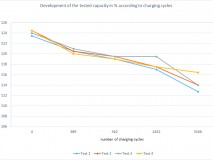
Long-term tests conducted by Sonnenbatterie in the field document the positive properties of lithium iron phosphate batteries with regard to long service life, which also results from a resistance to capacity loss.
I also edited this article for „ees International – The Electrical Energy Storage Magazine“, where it has also been published.
Definitions:
Depth of discharge
This parameter specifies the percentage of stored energy that can actually be discharged from a battery system without damaging the battery. The background of this is that excessive discharging permanently reduces battery capacity. This so-called depth discharge depends on the employed technology. The limit value for this depth discharge usually ranges from 50 to 10 percent.
Efficiency factor
The efficiency factor expresses the ratio between the retrievable energy of a charged battery and the previously supplied energy as a percentage. Because energy storage and discharge is usually coupled with loss, the efficiency factor is under 100 percent. The main cause of loss is the internal resistance of the battery cells during system charging and discharging.
Number of cycles and calendar life
The achievable number of cycles refers to the full charging and discharging cycles. It specifies the total number of times a system can be charged and discharged. Calendar life denotes the time period after which at least 80 % of the original capacity is still available before the designated number of cycles is exceeded.
Related Posts
The service life of energy storage solutions depends not only on cell chemistry but also on external influences. Properties which are a must for rechargeable batteries in consumer electronics and mobile applications are less relevant in stationary batteries such as solar energy storage systems. Factors like ambient temperature, depth of discharge and cycle stability have… read more
