
Tags
Blogroll
OVERVIEW
In the face of the global climate change, around 560 GW of renewable energy plants have been built in the last few years*1. These renewable energy plants are mainly Energy harvesting machines. The size of the plants ranges from a few kWp up to several hundred MWp.
Design criteria were maximum yield at minimum cost. Downstream costs for grid expansion or functions such as frequency control, or voltage control were not required. As a result, the energy production from these renewable energy plants must be reduced during times of maximum power production, so that the Must-Run conventional power plants can be permanently operating at high load level to provide grid-stabilizing services such as frequency or voltage control. The result is a disproportional rise in energy costs. This undesirable development can be stopped with innovative system solutions and a cost effective „Energiewende“ is possible.
The economically sensible alternative to conventional Must Run Power Plants producing energy from fossil fuels is a Hybrid Power Plant consisting of a renewable energy producer, high energy storage and flexible conventional Power plants at one grid connecting point.
This is the reason why Belectric has developed a new Hybrid Power Plant design, which can handle any Power Plant configurations and any grid requirements. With this solution, Belectric is in a position to offer best-in-Class quality with maximum cost efficiency. The Belectric Hybrid Power Plant can consist of a PV Power Plant, MW-Storage Solution, conventional Power plant, hydro power plant, BHKW’s or wind generators. Through intensive research collaboration with the global players in the sector of energy production, Belectric has the possibility to individually customize the generation and storage units according to the individual requirements.
System Design
A detailed System configuration and layout as well as an exact energy yield simulation are very important before each hybrid system implementation. In the Simulations, it is of paramount importance to consider the grid-stability requirements. Via a simulation tool developed in-house by Belectric, it is possible for Belectric to validate its system design whose actual functioning is accurately modified and reflected in the simulation results. Besides the requirement of voltage and frequency control or grid forming functions and its control mode, the system also considers power plant specific behaviours such as minimal load of gensets or switch-on characteristic of conventional power plants. The result is a realistic and cost optimized system design for the required application.
In the above example it can be seen that for a hybrid system consisting of a conventional power plant and a PV power plant, the PV output must be significantly reduced to accommodate the minimum load of the conventional power plant. Additionally, the conventional producer must cover the control reserve for load or production fluctuation.
The above diagram shows the advantage of integrating a Battery storage system to the Hybrd plant. The battery storage provides the system control reserve and the Must Run power plant can be turned off and a higher energy from the PV plant can be utilized. The used Capacity in relation to the needed Power from the battery storage is very small. Thereby the investment costs are not too high, if you use a high power battery. But the saved opportunity costs are significant in terms of saved fuel and minimizing maintenance cost of the conventional power plant. Therefore, while evaluating the feasibility of Battery storage in a hybrid power plant, it is essential to evaluate the total system cost and not just the pure cost of energy storage.
Innovation PV
The main advantages offered by Belectric Solar Power Plants are not only their at least 25 years life time and maximum yield but also their low system costs – a result of its standardized block design. Additional benefits include a simple design with low maintenance costs and a complete monitoring system, which guarantees a reliable operation at all times. Through its self-developed control regulation system, Belectric is able to provide voltage regulation with the PV Power plant 24/7. A highly precise (in the seconds) power regulation of the PV plant the exact forecast provides the possibility of using the power reserve for grid control reserve.
Innovative Battery storage
Belectric has developed a high power storage solution, which has the possibility to work with different central inverter technologies. Depending on the inverter technology used, the storage system has the ability to form the grid in an island grid or provide black start capacity for an interconnected grid. Given the very low reaction time (a few milliseconds) to local load conditions, grid stability can be guaranteed even with low real rotating mass.
The Battery system is designed for maximum availability. With the redundant SIL2 approved safety control system, the battery storage system ensuresthe power availability even in extreme situation. The Belectric EBU use innovative, newly developed high power lead acid batteries. These batteries have minimal cost per kWh and have the option of a power capability of 1,5 C. This helps ensure that
the required power reserve with minimum battery capacity, enabling the switch-off of the conventional power plant. This new Battery solution with innovative charge control system gives the possibility of 5000 equivalent full cycles.
Innovation Genset
In co-operation with MTU, Belectric has developed an optimized operation management for Diesel engines in a PV-Hybrid Power plants. The advantages are the reduced minimum load of the generators and a fast start of the gensets in less than 30 seconds.
Innovation Hybrid controller
The power plant controller (Hybrid controller) manages the division of the reserve control amongst the different generation sources and defines the control response. The optimization of the load balancing is carried out by a global cost optimization function, which determines the minimum production costs at any given time for the complete hybrid system.
The protection of the grid stability has priority and is taken into account in each decision of the controller. But the division of the reserve control is also optimized by a global cost optimization. The novelty of this optimization is its universality. No generation source has a fix priority over the other. Every unit has its own specific cost function which is integrated within the global cost optimization. The forecast has a crucial influence on the global optimization. With this optimization, the algorithm can be easily adapted to a new producer in the Hybrid power plant.
Source: Dipl.-Ing. Lars Fallant, Belectric
Related Posts
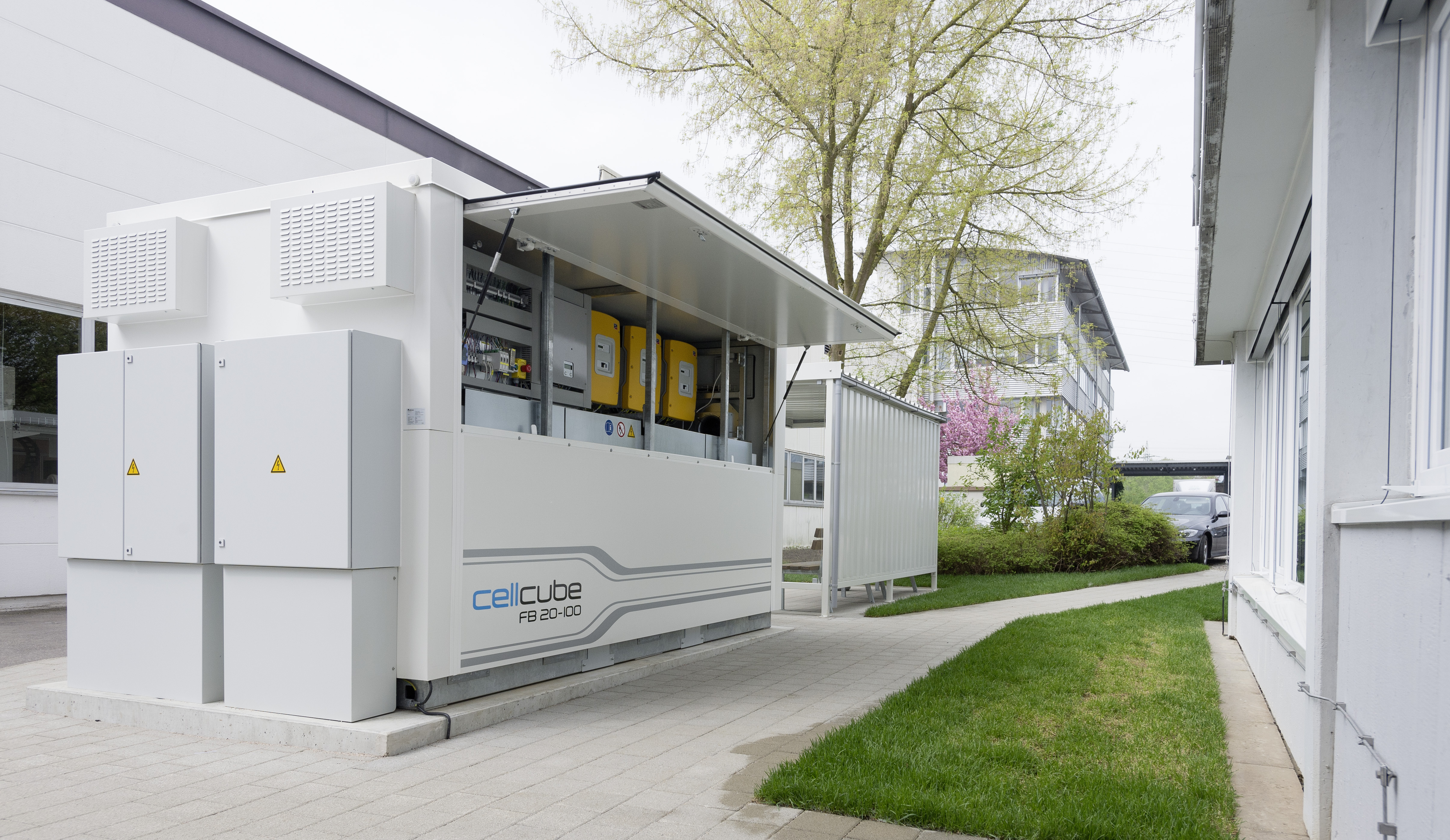
Businesses are equally as capable of directly using solar power generated on site as private householders. All that’s needed is a photovoltaic installation and a smart large-scale battery which conducts electricity to various systems and devices that consume power as and when it is needed. Drawing on the example of a systems manufacturer from Germany’s… read more
