Tags
OVERVIEW
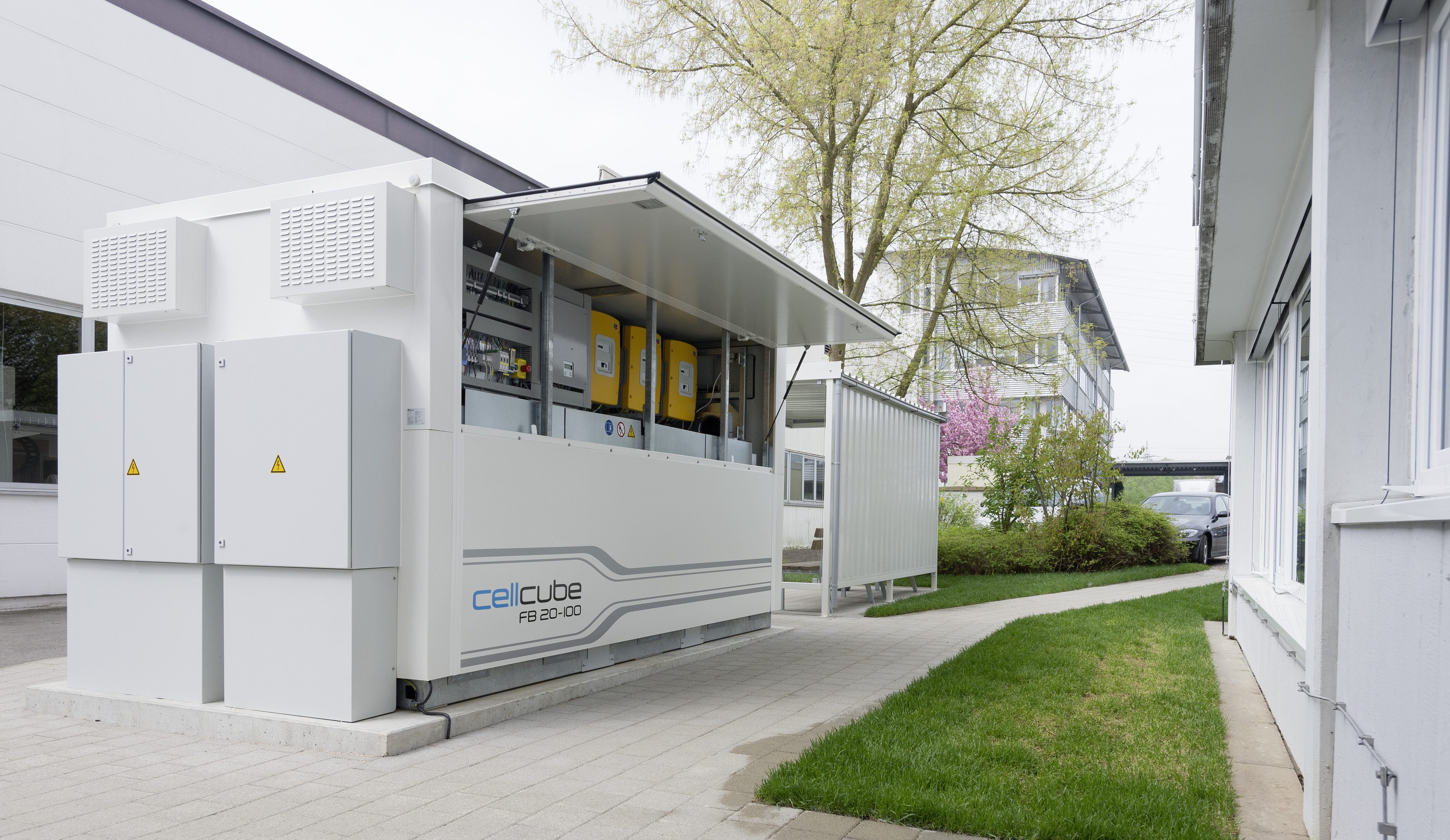
energy storage CellCube (Foto: Ralf Grömminger © Solar Promotion GmbH)
Businesses are equally as capable of directly using solar power generated on site as private householders. All that’s needed is a photovoltaic installation and a smart large-scale battery which conducts electricity to various systems and devices that consume power as and when it is needed. Drawing on the example of a systems manufacturer from Germany’s region of Swabia, this article highlights how businesses can benefit from on-site consumption.
Everything was moving too slowly for Stefan Roßkopf. Although the German government has been talking of kick-starting e-mobility for years, only a relatively small number of electric cars have taken to Germany’s streets to date. “While China is pumping more than a billion euros into the sector, Germany’s policy makers and industry have seemed to let this trend completely pass them by,” complains Roßkopf, the managing director of teamtechnik, a company specializing in automation based in Freiberg am Neckar. In light of this, Roßkopf made a resolution last year: teamtechnik would develop its own e-mobility project to send out the message that change is needed. The ambitious entrepreneur invested €300,000 for the construction of a new photovoltaic installation complete with a storage battery and electric filling station at his company’s headquarters. Since April, two self-sufficient charging stations have been supplying the medium-sized company’s small fleet of electric smart cars, with any excess electricity being used to power its own production processes or being fed into the public grid.
“Companies with high levels of technical expertise like us must drive forward the energy transition,” states Roßkopf. Saying this, protecting the climate was not the only motivating factor behind the project. teamtechnik constructs assembly systems and test facilities for sectors including the automotive and photovoltaics industries, and is a renowned specialist in manufacturing equipment for the drivetrains of modern hybrid and electric vehicles as well as in the cost-effective production of solar modules. Its latest project is allowing the company to demonstrate its innovative strength in terms of combining e-mobility with photovoltaics. Although under current conditions it will take more than ten years for the new energy system to pay for itself, the solution that teamtechnik has designed to facilitate on-site consumption could serve as a blueprint for future energy projects.
The success of the energy transition is dependent on two factors: As weather conditions mean that solar and wind power are only ever available erratically, to ensure more green power is generated, grids must be expanded and storage systems installed that make renewable energy production predictable and competitive. E-Mobility could give additional impetus to the energy transition. By filling up on excess green power and releasing it when it is required elsewhere, electric cars, like storage systems, are able to compensate for fluctuations in energy production and are therefore a vital part of a smart power grid. Smart grids are still in their infancy, with key components such as batteries and communication technology systems continuing to require a lot of development. teamtechnik has been able to prove, however, that the interaction of renewable energy, storage systems and electric cars works well in principle.
The company’s starting point was to solve the problem of creating a charging station for a fleet of electric vehicles without any power being supplied from external sources. It was ascertained that on top of employees’ private electric vehicles, ten to fifteen electric cars were to regularly make use of the charging stations. One thing was clear from the outset: As a supplier to the photovoltaics industry, teamtechnik would rely on solar power to fuel its fleet. 347 multicrystalline modules, which were manufactured by its Chinese client Eging Photovoltaic Technology and had a total output of 86.75 kilowatts (kW), were therefore installed on the roof of one of its production halls. However, the challenge was ensuring that the cars could be charged even during overcast weather or at night when the solar plant was not generating any electricity. The solution came in the form of the CellCube FB 20-100 vanadium redox-flow battery designed by GILDEMEISTER energy solutions, a division of machinery manufacturing company GILDEMEISTER, which is based in Bielefeld, Germany and is the firm that took responsibility for planning the project. The high-performance battery is around the same size as a construction trailer, boasts a capacity of 20 kW and is capable of storing 100 kilowatt hours (kWh) of solar power – more than ten times as much as a domestic storage system.
“teamtechnik’s photovoltaic installation and battery have been designed to make sure that energy is available around the clock, even when the solar irradiation is low for several days in a row,” explains Stefan Schauss, a technical sales and distribution representative for storage systems at GILDEMEISTER energy solutions. An energy management system integrated into the CellCube distributes the solar energy generated on the hall’s roof according to pre-defined priorities. Firstly, the two charging stations are each supplied with 52 kW of maximum charging power. When they are fully charged, the CellCube is then supplied, with it taking five hours to fill its 100 kWh capacity. If the storage system is also full, the solar energy is used to power systems in teamtechnik’s production facilities. On days when no manufacturing processes are taking place, the excess electricity is fed into the public power grid and is remunerated by the regional utility company in line with the Renewable Energy Sources Act (EEG). The CellCube makes its stored solar power available at times when the photovoltaic installation is not generating any electricity. If neither the solar modules nor the storage system are able to supply energy, the public grid must be tapped into so that the vehicles can be charged. However, Schauss is certain that given the scale of the photovoltaic installation and battery, this situation is unlikely to arise.
There is an excellent reason why teamtechnik has chosen to rely on redox-flow technology for its project: Comparatively speaking, flow batteries are able to store large quantities of energy cost effectively. Unlike conventional lead-acid batteries or lithium-ion batteries, CellCube’s storage and power production systems are kept separate from one another. The electrical energy is stored in a liquid form in two independent tanks, which enable the required capacity to be easily adapted and can be produced relatively economically. It is only during the charging or discharging stages that the electrolytes start to flow slowly through the cells, which then supply power or store it in the form of ion solutions. Redox-flow batteries are also advantageous because they are capable of being deeply discharged without adverse effects and only lose minimum amounts of charge when not in use – in conventional batteries, both of these factors are often decisive disadvantages. “The electrolytes do not wear out and can be reprocessed after their service life,” explains Schauss. GILDEMEISTER energy solutions indicates that these qualities result in the CellCube having a lifespan of 20 years.
In addition to its high utility value and despite being technically complex, the system is easy to install. Since GILDEMEISTER energy solutions delivers a turnkey battery, it simply needs to be connected to the photovoltaic installation’s inverter, the charging stations and the public grid. teamtechnik’s solar modules and CellCube were installed by B&W Energy from Heiden in the German region of Münsterland. “The whole process was relatively easy,” confirms B&W Project Manager Andre Krause, before adding that GILDEMEISTER energy solutions had completed all of the preparatory work itself, including assembly, filling the system and charging the battery. “We only took responsibility for calculating its capacity and laying the cables.” B&W also connected the system to the grid. “That too was quite simple, as the grid operator had set no specific requirements,” explains Thomas Spirres, who is in charge of grid connection management at B&W.
The smooth way in which the project was implemented and the first impression created by the energy system after a few weeks of operation have also left teamtechnik’s managing director, Stefan Roßkopf, feeling satisfied. “We’re going to keep a close eye on how everything goes over the next few months and then, if necessary, expand our CellCube system.” Stefan Schauss from GILDEMEISTER energy solutions reports that an increasing number of companies are expressing an interest in the new battery, the latest version of which was on display at Intersolar Europe 2013 in Munich.

The electro-Smart-fleet is charged with energy from the photovoltaic system (Foto: Ralf Grömminger © Solar Promotion GmbH)

One of teamtechnik’s electro smart (Foto: Ralf Grömminger © Solar Promotion GmbH)

Functionality of the Vanadium-Redox-Flow-Batterie (Foto: Ralf Grömminger © Solar Promotion GmbH)
The case-study, comissioned by Intersolar Europe, can be found in IKZ Haustechnik, issue 11 / 2013, under the title: “Blaupause für künftige Energieprojekte” (blueprint for future energy projects).
