Tags
OVERVIEW
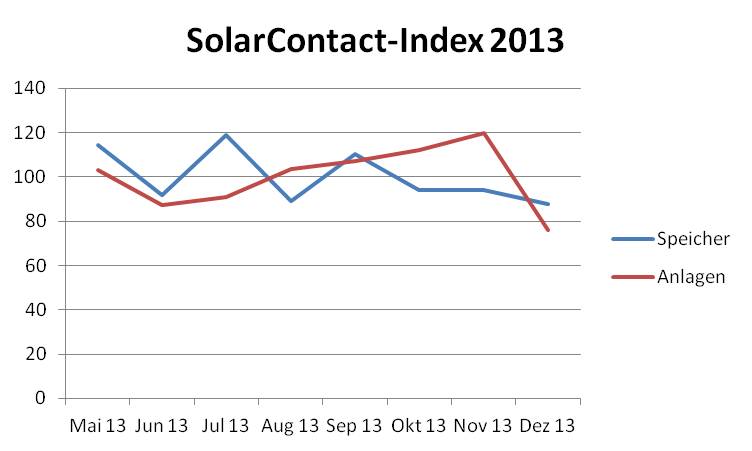
SolarContact-Index 2013 (Quelle: SolarContact)
Solar storage systems have been subsidized since May last year. These incentives can be used for photovoltaic installations that are yet to be built as well as for retrofitting installations that were commissioned after December 31, 2012, up to a maximum of 30 kWp of PV capacity. The German Solar Industry Association reported that the repayment grant applications of 2,300 households had been approved by the end of November. A special evaluation by the SolarContact Index has now provided more insight into how the incentives have impacted the storage system market. The evaluation showed that effects could only be seen in the first few months after the incentive launch.
Uncertainty arises from flaky start to the incentive program
By evaluating how often solar storage systems were inquired about between May and the end of December, we can see that end-customer interest in solar storage systems only perked up in June, despite the incentive program’s launch in May. This may be traced back to the flaky launch of the storage incentive program. Although the German parliament planned to provide state incentives for buying solar storage systems back in June 2012, with incentive details and the May 1 launch date trickling through at the beginning of February 2013, these incentives were put onto the backburner at the end of February as financing by the “Energy and climate fund” was still up in the air. The German Federal Ministry for the Environment only confirmed the financing for storage system incentives in mid-April 2013 – presumably too late to have an effect on the market demand in May when the incentive program was launched.
Interest in storage systems decreases at the end of the year
During the months that followed, interest in PV storage systems got off to the same bumpy start experienced by the storage system incentives. Low interest in June was followed by a peak of 119 index points in July, only to sink back down to 89 points in August, one of the lowest results of the entire year. While interest in storage systems then peaked again in September, the last quarter of 2013 was characterized by below-average interest, hitting a low of 88 index points in December. The highs and lows of inquiries from May to July can be attributed to a lack of information provided to suppliers and end customers about the conditions and economic viability of the storage incentive program. The fact that interest continued to decline after the peak in September is probably due to fundamentally dwindling interest in retrofitting existing PV systems as well as in combined new installations. This conclusion seems logical because interest in PV installations continued to increase between August and September and only dropped again in December for seasonal reasons.
Positive economic conditions
The dwindling interest in small electricity storage systems may be attributed to an increase in purchase costs and the resulting storage costs per kWh compared to the difference between domestic electricity prices and the pure costs of generating electricity from PV. In 2014, however, electricity storage systems could become more economically attractive in all aspects. It now seems certain that domestic electricity prices will rise further in 2014 after a certain reluctance displayed by electricity suppliers. The costs of generating electricity from PV will also slowly but surely continue to decrease, which will soon mean that the resulting difference considerably exceeds variable storage costs. And storage systems are still being developed. While the market initially leaned towards storage systems that guaranteed an almost complete intake capacity of PV power, nowadays the focus is on optimizing the economic viability of modern storage systems. What’s more, the market is increasingly brimming with new operating concepts that would allow storage systems to perform, and be financially compensated for, additional services such as load management. With January boasting 104 index points, this year is at least off to a positive start.
About the SolarContact Index
Run by the DAA Deutsche Auftragsagentur in Hamburg, the SolarContact Index is based on the online demand for all photovoltaic installation works. The DAA is Germany’s largest service provider of online inquiries about renewable energy technology. For more than three years, it has been concentrating on procuring projects for solar installations, heating technology and insulation and renovation works. By means of a large network of partner websites, the DAA aggregates a significant amount of all internet inquiries about photovoltaic installations made online. Information from all of these projects is used to calculate a monthly average for the past 12 months. This index makes it possible to evaluate the current demand for photovoltaic installations as well as predict the orders and additional installations that can be expected in the future.
Related Posts

Since May 1, the German government has been supporting the purchase of solar storage systems by awarding grants of up to €660 per kilowatt (kW) of a solar system’s installed capacity. It is important to note that the subsidy must be applied for via your principal bank before the storage system has been bought. Government… read more

The move towards independence and self-sufficiency is encouraging more and more people to generate their own power. By using their own solar installation, more than 1.3 million people are already making a stand against the energy oligarchs. It is therefore no surprise that the solar storage system incentive program has been very well received: solar… read more
Does the grid really need batteries? This is currently a very controversial question. Some experts even consider the technology to be detrimental and that’s why they are strictly rejecting Germany’s planned incentives. Fraunhofer Institute for Solar Energy Systems (ISE) counters this argument in its new Speicherstudie 2013 (study on storage systems): Batteries can actually take… read more
