Tags
Blogroll
OVERVIEW
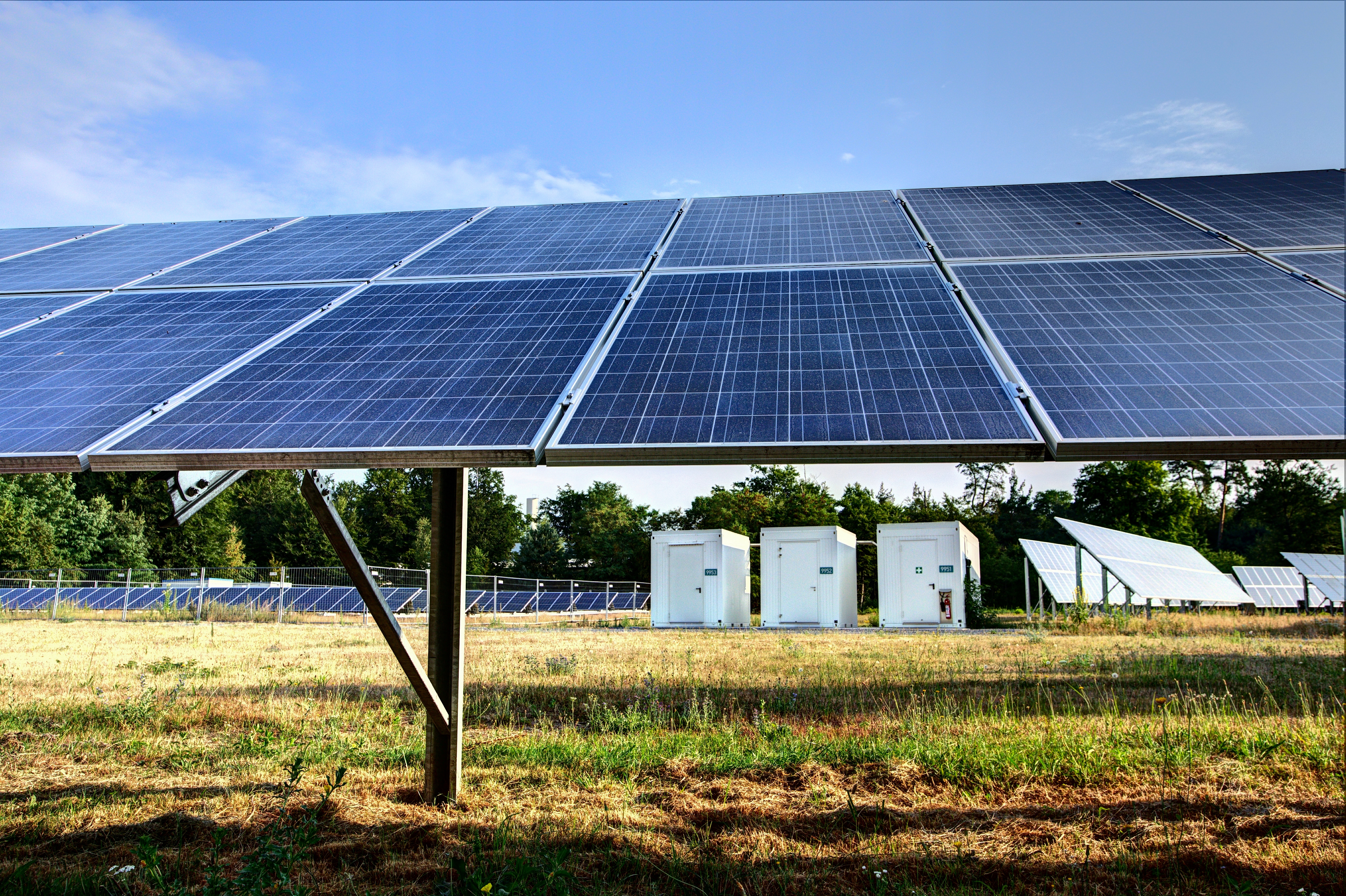
Energy storage systems with lithium-ion batteries have the potential to play a decisive role in the establishment of an efficient and sustainable future electricity supply. Widespread deployment of this technology depends to a large extent on whether the energy costs in each specific application are financially competitive. The basic prerequisites for the successful commercial operation of PV-storage systems will be discussed in more detail below.
Some of the critically important aspects affecting commercial viability are:
• the system design (AC- or DC-coupled),
• the dimensioning (relative sizes of PV-Array, battery and power electronics),
• the level of development of the system control software,
• the calendar and cycle life of the battery and electronic components.
In addition, the interplay between hardware and software must be fast and reliable to ensure a high level of security and availability. The successful evaluation of these criteria requires comprehensive testing in the field. To this end several prototype stationary storage systems with differing configurations have been in operation on the Karlsruhe Institute of Technology (KIT) campus since 2013, as part of the project “Competence E”. In 2015 another system at the Helmholtz Institute in Ulm started operation. These systems provide an ideal testing ground for newly developed hardware as well as for novel algorithms for system control and operation; the experience gathered provides detailed insights into application-specific storage system design, taking both technical and economic aspects into account.
In the following the term “stationary storage system” refers to a system comprised of a PV-array, a Li-ion battery storage device as well as the corresponding power electronics components. This can be justified by the fact that at most locations on earth the energy generated by PV-arrays is the most cost-effective way to use renewable energy to cover electricity demand. Other systems such as the combination of one or many wind turbines or other renewable energy sources with a battery are of course equally conceivable.
From a technical perspective there are in principle two distinct ways (system design) to couple the energy sources and storage devices to each other. In an AC-coupled system all renewable energy is fed directly into the AC-grid. The battery itself is also coupled to the AC-Grid via a bidirectional AC/DC inverter and can be charged or discharged as required. In contrast, in a DC-coupled system the energy is first fed into a DC-Bus via voltage transformers or rectifiers, and the battery is coupled to the DC-Bus with DC/DC converters (see Figure 1). There are pros and cons to both configurations: AC-coupling is better suited for retrofitting existing installations, whereas DC-coupling generally has benefits in terms of the cost of the electronic components. The overall system efficiency often depends on the correlation between the size of the power electronics components and the desired load profile. Other system-independent factors that can strongly influence efficiency are auxiliary loads such as heating or cooling as well as consumption from the battery management system, for example. There is to this day no consensus as to which configuration will establish itself and for which application, so that both variations were assembled and tested at KIT, with different industry partners.
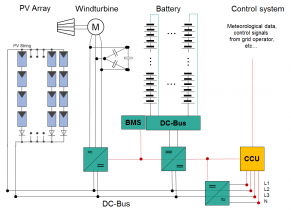
Figure 1: Production and storage of renewable energy in a DC-coupled system
The main aspects of storage system dimensioning are the choice of PV-array size and orientation, along with the appropriate battery capacity and the correct nameplate ratings of all electronics components. The goal is to identify the most economical combination as a function of the customer’s requirements and the local conditions. An example of the latter could be the current local electricity price, whereas a typical customer prerequisite could be the attainment of a specific degree of self-sufficiency. In practice one often finds that potential customers struggle to precisely stipulate the requirements for a battery storage system, let alone to prioritize them clearly. Thus a careful consideration of the relationship between load profile, potential supply of renewable energy, prevailing cost structure of the local power supply and customer expectations is unavoidable.
Since renewable energy production and in most cases also the load profile can exhibit significant fluctuations during the course of the year, it is vital to consider both the load and available solar radiation throughout the year. While the variations in radiation are location-dependent, increasing with distance from the equator, those of the load profile depend on the system operator. For example, in certain industrial areas the fluctuations could be very small, whereas those in an island grid could be extremely severe, primarily due to the large variations in tourist activity during the course of the year.
The battery is currently still the most expensive component of a stationary storage system: the smaller it is, the lower the final unit cost of electricity will be. In most cases this can be achieved by synchronizing the energy generation and load with each other; one way of doing this is to install PV-arrays at different orientation angles (see Figure 2). Daily surplus energy production is thus minimized, which in turn allows the battery capacity to be reduced.
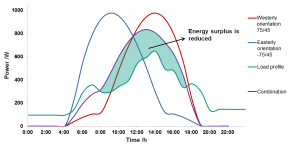
Figure 2: Daily power profiles of three different PV systems. Two of the systems have only one orientation direction, west and east, respectively, whereas the third combined-system is comprised of arrays in different directions. The latter correlates more with the customer’s load profile, thus allowing one to achieve the same degree of self-sufficiency with a smaller battery.
Further cost optimization can be achieved by simulating the system as whole, which allows one to determine how many equivalent full cycles the battery should be able to endure throughout the planned project timespan. A good cycle performance helps avoid repairs or replacements. Note that “equivalent full cycle” refers to the number of full charge and discharge cycles the battery can deliver in a specific application until the end of its life. The required cycle performance for such systems is remarkably high – for a 15 year lifetime at least about 5000 cycles are needed. This is in part due to the fact that the battery is often undersized because of its proportionally high costs. At the same time, simulations show that in stationary energy storage applications it often suffices to size the power electronics and battery so that maximal C-rates of 1C ¹ or even only 0.5C can be achieved.
Figure 3 depicts the total energy cost in €/kWh of the operator’s entire energy usage as a function of the degree of self-sufficiency attained, for different battery capacities. This includes both the cost of electricity produced by the storage system as well as that of the energy sourced from the grid. It is clear that the achievement of a certain degree of self-sufficiency can result in widely varying costs, so that at the end of the day the correct system sizing can lead to significant savings.
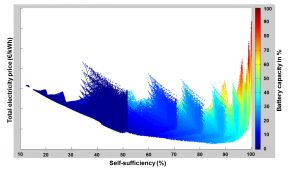
Figure 3: Total electricity costs of a storage system operator as a function of self-sufficiency and battery size. The costs include production costs from the system as well as costs for energy externally sourced from the grid, where an amortization of 15 years has been assumed. For simplicity the costs due to maintenance interest were neglected.
Here the simulation is performed for a DC-coupled storage system in a stand-alone island grid, with two PV-arrays of different inclination and orientation angles (see Table 1).
| Angle variations of the PV array | |
| Inclination angle | 0° to 45° in 15° increments |
| East-West orientation | 90° to 90° in 15° increments |
As has already been mentioned, the system control software plays a critical role in the economic viability of storage systems, which should be regulated in such a way as to maximize the self-supply ratio. The underlying algorithms must also ensure the longest possible operational lifespan of the battery; in particular the various electrochemical processes that take place during the normal operation of a lithium-ion battery must be taken into account. Another vital component of the software is its ability to predict both the energy needs of the customer as well as the energy supplied by the PV-array, throughout the day. In essence one needs to be able to predict the load as well as the available power, to deduce how the system should best be regulated in order to increase profitability. One concrete example of this is that excess energy should not be stored in the battery right at the start of the day, but rather only after midday, since lithium-ion batteries age faster when their state of charge (SOC) is high. For specific cell chemistries it can also be advantageous to avoid other SOC ranges, e.g. 30% to 50%. All of these factors require not only extensive expertise but also serious brainpower in the control system, since one has to decide in advance when and with what power the battery should be charged or discharged in order to simultaneously maximize self-supply and ensure a long battery life.
An intelligent charge/discharge regime also benefits the grid operator: due to delayed charging the battery is not completely full around midday, enabling the system to perform peak-shaving of excess PV production that usually occurs around this time. A reduction of such peaks of up to 40% of the installed PV power has been shown to be possible [1], but in each case this obviously depends on the system’s specific dimensions. Peak-shaving can also increase the overall system profitability in cases where the maximum power that can be fed into the grid is limited by law: during times of high PV production the predictive control system ensures that the excess energy is stored without having to throttle the PV generators[2].
The control system must also be able to smooth fluctuations both in PV energy generation as well in the load profile. During the course of the day those variations can be prodigious, as shown in the example in Figure 4, where the high variability of PV power production is depicted. If the system as a whole cannot smooth these fluctuations fast enough it could happen that energy from the battery is fed into the grid or that energy is unnecessarily drawn from the grid, even though the battery could have provided it. This will always happen if the reaction of the battery system to fast changes in power demand or production is too slow, which in the end can reduce the overall profitability – self-supply is often economically more favourable than feeding into or sourcing from the external grid. The smaller the rates of change of generation and load, the less impact a slow reaction time will have. Figure 4 shows an example from one of the systems at KIT, in which a constant load is requested; it is evident that the battery can smooth the variations from the PV-array, even if they are very large, so that the power fed into the grid can be kept very nearly constant.
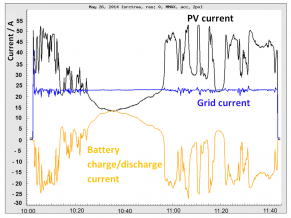
Figure 4: Data from the KIT DC-coupled system, measured on 20.05.2014. The current from the PV array, the current flow into the grid as well as the charge/discharge currents of the battery are shown, where a positive (negative) current means that the battery is being discharge (charged).
In conclusion it has been shown that the installation and operation of commercially viable storage systems is already possible today; this is however strongly dependent on the local conditions as well as on an intelligent system design. An application-specific planning process coupled with a thorough understanding of the interplay between all system components will ultimately lead to economic success and to the proliferation of this technology in the world electricity market.
¹The C-rate is the charge/discharge rate normalized by the nominal battery capacity – 1C means that the battery is completely charged or discharged within one hour.
Sources:
[1] Raphael Hollinger, Bernhard Wille-Haussmann, Thomas Erge, Jan Sönnichsen, Thies Stillahn, Niklas Kreifels, Speicherstudie 2013 – Kurzgutachten zur Abschätzung und Einordnung energiewirtschaftlicher, ökonomischer und anderer Effekte bei Förderung von objektgebunden elektrochemischen Speichern, Fraunhofer ‐ Institut für Solare Energiesysteme ISE in Freiburg im Auftrag des Bundesverbands Solarwirtschaft (BSW ‐ Solar), Freiburg 2013
[2] Johannes Weniger, Joseph Berger, Tjarko Tjarden, Volker Quaschning, Dezentrale Solarstromspeicher für die Energiewende, BWV Berliner Wissenschafts-Verlag, Berlin 2015
Authors: Nina Munzke & Dr. James Barry, Karlsruhe Institute of Technology, Project Comepetence E
Cover picture: Walter Rasch ©
Related Posts
Interest in solar installations with storage systems is rising because these systems reduce consumer dependency on utility companies. So far, there has been little investment into the new technology due to high battery costs – but this may soon change: Thanks to higher production rates and technical advances, costs are sinking fast. It’s always the… read more
