Tags
Blogroll
OVERVIEW
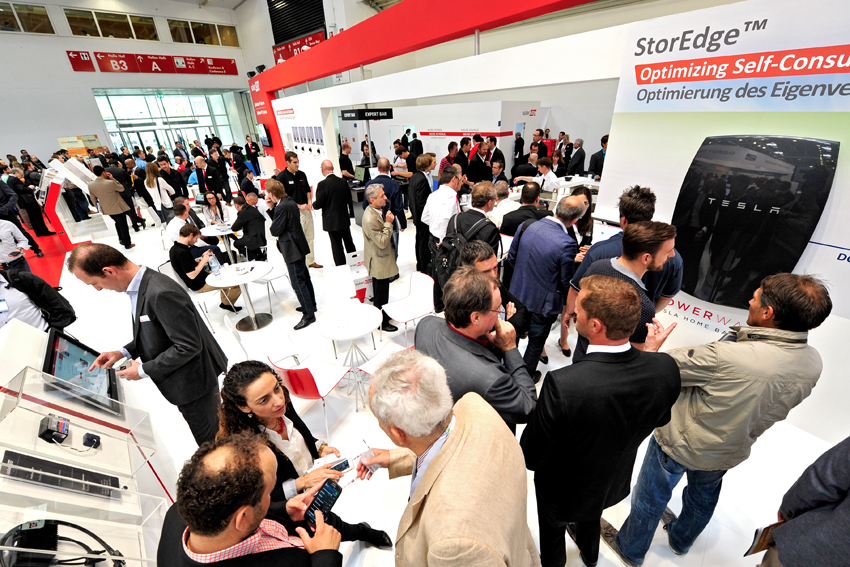
Tesla PowerWall at the SolarEdge booth during Intersolar Europe 2015
With the entry of Tesla and Daimler onto the market for domestic battery storage systems, small and medium-sized suppliers are under pressure to act fast. If they are to compete with the big players in the long term, they must do all they can to lower costs and develop innovations. However, despite such conditions, these smaller companies are not showing any signs of concern. After all, they have long been offering the products and services only now being planned by corporate groups.
US electric car developer Tesla may have been the first to unveil plans to revolutionize the storage market, but no sooner had its new Powerwall battery system been announced than German car giant Daimler followed in its footsteps. The Stuttgart-based automotive company intends to launch stationary energy storage systems for domestic consumers with its wholly owned subsidiary Deutsche ACCUmotive this summer. Daimler is planning to manufacture the lithium-ion batteries in ACCUmotive’s production facility in the town of Kamenz in Saxony and cooperate with sales partners, such as energy utility EnBW.
For small and medium-sized storage system providers, the arrival of these corporations on the market holds just as many opportunities as it does risks. While this development could boost the popularity of domestic storage systems, smaller companies need to ask themselves what they can do to stand out against their powerful new competitors in the long term. Parallels can be drawn with the photovoltaics industry, where innovative module manufacturers laid the foundations for advanced solar technology, only to be later driven from the market by financially strong Chinese corporations and their cheap, mass-produced goods.
Now, the German storage market has also become attractive to big players. Since the launch of the market incentive program for solar battery storage systems two years ago, the Kreditanstalt für Wiederaufbau (Reconstruction Credit Institute, KfW) has funded around 10,000 systems with loans amounting to 163 million euros. Meanwhile, additional growth is on the horizon: With solar power becoming less expensive and the subsidies that were set to be phased out at the end of this year looking likely to continue, domestic consumers are becoming increasingly interested in on-site consumption. It is these developments that have attracted the corporations.
Nevertheless, small and medium-sized enterprises seem unfazed. Since the topic of solar storage first emerged as an important issue five years ago, suppliers have consistently reduced system prices, increased the life span of their storage tanks and repeatedly integrated new features, enabling the devices to perform systemically relevant grid services. “No competitors are capable of offering such a completely well-thought-out system as ours,” states Detlef Neuhaus from Dresden-based company SOLARWATT, commenting on its new solar storage unit MyReserve. The device, which is currently being launched, has a storage capacity of 4.4 kilowatt hours, making it particularly suitable for single-family homes. By adding extra modules, however, this can be increased to 11 kilowatt hours for use by small businesses.
Neuhaus claims that MyReserve’s technical superiority stems above all from its high efficiency level of 93%. In storage systems, this figure indicates the percentage of stored electricity received back from the device, and stands at an average of around 90% in lithium-ion batteries currently on the market. Moreover, thanks to a special setting, MyReserve is compatible with all available inverters, allowing users to directly connect the device wherever they like. A further advantage, which is likely to be just as important as this freedom, is the product’s cost. According to Neuhaus, the system should pay for itself within a “reasonable period” of six to 12 years. Neuhaus adds that the price of electricity stored by the device is lower than the average gross cost of domestic mains electricity, which currently stands at 29 euro cents per kilowatt hour.
Sonnenbatterie, on the other hand, places emphasis on the long life span of its storage device, which is available with a capacity of four to 16 kilowatt hours. “Our lithium storage system is capable of 10,000 cycles, meaning that if it is charged and discharged 250 times annually, it may last for as long as 40 years,” states CEO Christoph Ostermann. What’s more, the company’s device is said to be capable of achieving 100% depth of discharge without deterioration, which indicates that its available capacity can be used in full. By way of comparison, other lithium storage systems available on the market are able to draw a maximum of 90% of their rated capacity.
Technical advances have also been made in the field of lead-acid batteries. Although they can only exploit half of their capacity and have a lower life span in comparison to lithium-ion batteries, they are advantageous in terms of their low purchase cost. Deutsche Energieversorgung estimates that, when taking into account the combined costs of the solar installation and lead-acid battery, its latest domestic storage system, the SENEC.Home 4.0 Pb, will supply electricity at 22 euro cents per kilowatt hour. According to the company, this means that the storage device, which boasts a usable capacity of four kilowatt hours, has the lowest specific cost of all systems in its class. The company has also increased the device’s minimum life span from 12 to 15 years, during which time it should be able to undergo 3,200 charge and discharge cycles.
To enable the system to make a meaningful contribution to stabilizing the power grid, Deutsche Energieversorgung intends to offer its storage capacity to the European Energy Exchange. More precisely, this will involve the company providing negative balancing power to compensate for increased supply and sudden drops in demand by connecting 5,000 of its own lead-acid batteries with electric immersion heaters as part of the recently launched Econamic Grid project. The cartridge heaters use the surplus power to generate hot water for showering and heating. The excess electricity is being made available to the participating private householders free of charge as, according to Deutsche Energieversorgung, if it were not used in this way, it would be given away abroad or even destroyed.
With this initiative, the company is on track to make a significant contribution to the energy transition. According to the results of a research project funded by the German Federal Ministry for Economic Affairs and Energy entitled “Interaktion EE-Strom, Wärme und Verkehr” (“The Interaction of Renewable Electricity, Heating and Mobility”), the use of a high proportion of renewable power in the heating market is essential in the long term if Germany is to achieve its climate targets. “The future of the heating market lies in the conversion of power to heat,” says Norman Gerhardt from the Fraunhofer Institute for Wind Energy and Energy System Technology IWES in Kassel, which has collaborated with other institutes to produce the “Roadmap Wärme” (“Heat Roadmap”). All in all, it is clear that German storage system providers are putting up a strong fight.
Related Posts
At this year’s Intersolar exhibition, SMA introduced the first mass-produced, wall-mounted PV inverter with an integrated battery and was promptly presented with an Intersolar AWARD, and for good reason: Together with the Sunny Home Manager, the Sunny Boy Smart Energy is designed to increase self-consumption of solar electricity in private homes by more than 50… read more
Energy storage and grid integration are two of the areas on which efforts towards the further expansion of solar power supply are centered. The increasing share of solar power is changing the power grid. That is why efficient energy storage systems will play a vital role in overcoming the current challenges – initially by integrating… read more
Interest in solar installations with storage systems is rising because these systems reduce consumer dependency on utility companies. So far, there has been little investment into the new technology due to high battery costs – but this may soon change: Thanks to higher production rates and technical advances, costs are sinking fast. It’s always the… read more
