Tags
Blogroll
OVERVIEW
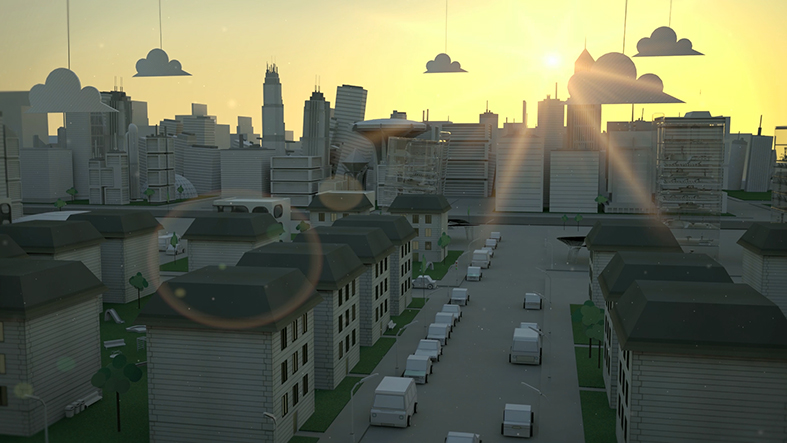
Project "Morgenstadt" (Foto: © Fraunhofer)
The fight against climate change will be decided in the large cities, say the experts. The idea is therefore to connect wind energy and solar installations intelligently with other power sources and consumers in conurbations. But this requires smart control and energy storage systems that remove some of the burden from the power grid. Will the industry be able to make the required investments in time?
Figures released by the UN give us pause for thought: Today, half of the world’s population lives in cities; a figure which is set to rise to 60% by 2025. Major cities such as New York and Berlin cover just one per cent of the earth’s surface, yet they consume 75% of all primary energy and cause 80% of the world’s greenhouse gas emissions. Urban planners and architects have got some monumental challenges ahead of them.
“The fight against climate change will be decided in the cities. The majority of their processes will have to become carbon-neutral, otherwise there’ll be a real chance of the climate collapsing,” warns Christiana Sager, a scientist at the Fraunhofer Institute for Building Physics (IBP). Together with 11 other Fraunhofer institutes, IBP has launched the Morgenstadt, or City of the Future, project. In this project, researchers want to use the six cities of Singapore, Copenhagen, New York, Berlin, Freiburg and Tokyo as examples to show how the energy transition can succeed in cities which face a wide range of different conditions. This much is certain: Green transformation requires a vast array of innovation. “What we need are intelligent electricity and heating networks to link energy generation and consumption across many different energy sources,” explains Christiana Sager.
Photovoltaics is considered a key technology for urban centers. Where solar modules cannot easily be installed on roofs, power-generating windows can be integrated into the building envelope, instead. Additional battery storage systems can raise the self-sufficiency of a building to 80%. The problem with using the power directly is that solar generation fluctuates and is often unavailable when you need it. Lead or lithium-ion batteries store the surplus, which can then be used as needed in the evening or the following morning.
Nevertheless, greening large cities will not be an easy task. Major urban centers will not be able to fully satisfy their own hunger for energy through green energy alone – even if demand falls. “Their capacity to produce renewable energy is not sufficient. At least some of the energy will have to come from the surrounding area,” says Kai Strunz, Professor of Energy at the Technische Universität (TU) Berlin. But Berlin, for example, could expand its share of carbon-neutral energy from 25% today, to 60% by 2037, according to a TU study entitled Intelligent Power Supplies for Berlin 2037. However, in order for this to occur, large quantities of wind power will have to be supplied from the other parts of Germany, and vast new wind farms will have to be built in the region surrounding the capital.
This is an immense technical challenge. External wind power and solar installations must be linked intelligently with all other power consumers and producers in the city, requiring industrial-scale storage systems and electric vehicles that absorb the spikes in production, thereby relieving the load on the grid. They will have to replace the pumped-storage power plants, which have been in common use up until now, but for which Germany, as a relatively flat country, actually has hardly any new suitable locations. Additionally, smart controllers are needed that can coordinate all of these components and adjust them to energy demand.
‘Virtual’ power plants offer a promising solution. This option consists of a number of decentralized energy producers that are linked to each other via a data connection. If a producer goes offline because of calm or overcast conditions, another supplier in the cluster gets the green light. The big players in energy and technology are currently pressing ahead to find connection solutions. Vattenfall has constructed a network of decentralized combined heat and power (CHP) plants in Berlin which, as a virtual power plant, can smooth out spikes from solar and wind energy. CHPs can produce the kilowatt hours needed to maintain grid stability, and to produce heat too, which can be used and stored in the buildings where they are installed.
Siemens has linked CHPs in Munich to wind and hydropower, and is developing automatic control units for the medium-voltage grid. With these, power plants can be controlled so that they are able to supply and absorb reactive power to and from the grid.
Innovations are also urgently needed in the field of large-scale storage systems. Two companies, Steag and Evonik, are testing large-format lithium storage systems in Völklingen, in Germany’s Saarland, with a one megawatt power and 700 kilowatt hour storage capacity. Other participants in the project, which is costing around €5 million, include Digatron Industrie-Elektronik, Li-Tec Battery, the EWE Next Energy Institute, Power Engineering Saar and the University of Münster. The aim of the project is to show that lithium-ion storage can reliably contribute to stabilizing the grid.
Redox flow batteries offer an alternative to lithium-ion technology, as they are capable of absorbing larger quantities of energy over longer periods of time. Energy-storing liquids are stored in two tanks outside of the battery cells, making redox flow batteries the only type of electro-chemical energy storage system where power and storage capacity can be adjusted to the application independently. One drawback of the system, however, is the amount of space it requires. Companies such as Vanadis Power, based in Nuremberg, Germany, are trying to find a solution to the problem by using chemical means to increase the energy density of the system: Scientists are enriching the electrolyte – vanadium ions dissolved in sulfuric acid – with additional chloride ions. According to the company, this enables more vanadium to be dissolved into the acid – this has the effect of doubling the energy density from 15 to 30 Watt hours per liter.
The researchers and engineers are under immense pressure since, if they do not manage to commercialize the technology swiftly and drive the storage system cost down quickly through technical improvements to the products and increased production levels, the City of the Future will remain but a bold vision.
Related Posts
For photovoltaics to play a leading role in the energy transition, energy storage systems need to reduce the burden on the grid and provide operating reserves, as well as being equipped with an intelligent energy management system that coordinates their usage. Will the industry succeed in developing the necessary technical solutions? In a renewable power… read more
Solar energy storage devices and heat pumps, in combination with small object-bound PV systems, can make an important contribution to the significant increase in internal consumption, the integration of renewable energy into the electricity grid, and to the establishment of smart grids. Another key requirement is for electrical and thermal storage to operate intelligently. This… read more
Energy storage and grid integration are two of the areas on which efforts towards the further expansion of solar power supply are centered. The increasing share of solar power is changing the power grid. That is why efficient energy storage systems will play a vital role in overcoming the current challenges – initially by integrating… read more
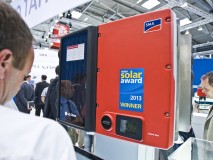
At this year’s Intersolar exhibition, SMA introduced the first mass-produced, wall-mounted PV inverter with an integrated battery and was promptly presented with an Intersolar AWARD, and for good reason: Together with the Sunny Home Manager, the Sunny Boy Smart Energy is designed to increase self-consumption of solar electricity in private homes by more than 50… read more

Kommentare (3)
” die bisher gängigen Pumpspeicherkraftwerke ersetzen, für die es im relativ flachen Deutschland kaum noch geeignete Standorte gibt ” eutschland ist nicht flach sondern zu 2/3 bergig .Allein am Rheingraben in Baden Würthemberg gäbe es sehr viele mögliche Standorte für Pumpspeicherkraftwerke.Diese sind mit einem Wirkungsgrad von über 80% zur Zeit auch die einzige wirtschaftliche und technisch erprobte Lösung – zudem Umweltfreundlichg !
Kommentar
Redox Flow Batterien versprechen viel für die Zukunft -sind aber bisher noch im Erprobungstadium. Einen wirklichen Fortschritt wird es aber erst geben , wenn Speicherkraftwerke von Investoren auf wirtschaftlicher Basis betrieben werden – und diesen Investoren die Wahl der Technik überlassen wird.Die Politik muß die Rahmenbedingungen für einen freien Markt setzen -mehr nicht !
Vielen Dank für Ihren Kommentar. Sie haben recht: Die Politik muss die Rahmenbedingungen für einen freien Markt setzen. Würde sie es tun, würde allerdings niemand in neue Pumpspeicherkraftwerke investieren. Sowohl Spitzenlast- als auch Pumpspeicherkraftwerke arbeiten inzwischen am Rand der Rentabilität, und so überlegen sich Betreiber derzeit eher, ihre Anlagen stillzulegen. Auch geplante Neubauten wie das Pumpspeicherwerk Atdorf im Schwarzwald stehen auf der Kippe. Nach Aussage des badischen Schluchseewerks, einer Tochter der Energiekonzerne EnBW und RWE, kann es unter den jetzigen Marktbedingungen nicht gebaut werden. Grund sind ausgerechnet die Erneuerbaren, die dringend auf Speicher angewiesen ist. Der hohe Anteil von Solarstrom im Netz verdirbt den Pumpspeichern den Preis. Ihre Betreiber leben davon, dass sie den Strom, mit dem das Wasser vom Unter- ins Oberbecken gepumpt wird, billig einkaufen, ihren erzeugten Strom aber relativ teuer verkaufen – vor allem in den Mittagsstunden, wenn Bedarf und Preis hoch sind. Genau in diese bisher lukrativen Mittagsstunden drängen nun die Photovoltaikanlagen und erhöhen das Stromangebot. Um Speicherengpässe zu vermeiden, müssen andere Wege gegangen werden als über Pumpspeicher.
I think this article makes some important suggestions. I only wish it had emphasized the importance of IMPROVING the existing grid, rather than allowing the reader to assume that society will ABANDON the grid.
Certainly, solar power will evolve into our primary, de-centralized form of energy production, as per sq. meter of earth’s surface, it is far more abundant than hydrocarbons.
But as humans become more concentrated in urban zones, there will also be a continuous need to concentrate power production and distribution, in order to guarantee the provision of bigger amounts of electrical energy. We must also consider the need to store energy for use when solar is not readily available.
My opinion is that concentrated wind power is a failed concept. Wind Farms are only considered “productive” while they are reaping huge government subsidies. The Wind Farm concept is probably more practical for small scale rural communities in those areas of the world similar to the North American plains or Central Asian Steppes.